Instagram inauthentic behavior policy: what breaks it and who decides
The Instagram inauthentic behavior policy is Meta's rule against using fake or controlled accounts to mislead people about who is behind something, how popular it is, or to dodge enforcement. Meta's reviewers and detection systems decide when a pattern qualifies, and the rule also covers bought engagement and abuse of the report button.
- Instagram applies Meta's Inauthentic Behavior standard; its latest dated change log entry is 11 December 2025.
- The rule treats the report button used as a weapon as a breach, so burner-account report scripts fall under it.
- Instagram's guidelines ban artificially collecting likes, followers or shares and paying money for engagement.
- Meta keeps its coordinated label (CIB) for sophisticated networks aimed at public debate.
- Since August 2020 Instagram can ask an account to confirm who runs it when it sees signs of automation.
What the Instagram inauthentic behavior policy covers
The Instagram inauthentic behavior policy bans fake or controlled accounts used to mislead people about identity, popularity or ownership, or to dodge enforcement.
Instagram does not keep a separate rulebook for this. Its own guidelines say that on 12 November 2024 they moved to Meta's Transparency Center and became the Community Standards, with no change to the rules themselves. So the rule that applies on Instagram is the same Meta text Facebook uses.
People land on this rule from three very different places. Some got a warning about their own account. Some suspect a rival of buying likes. Others are watching a ring of new profiles pile onto one person. Each needs a different part of the rule.
Vanquell is a small Telegram marketing and content takedown team that reads these cases against the written rule before anything is filed. Our case reviews stop at preparation. We gather the evidence and name the route, and Meta's reviewers and detection systems make the call. Nothing we write can undo what their systems have already decided.
The same idea runs through our Telegram work, where outreach goes only to people who opted in. Our note on which delivery routes Telegram actually allows for bulk messages starts from that consent.
What Meta's rule text says, and the line guides skip
Meta's rule has four main "do not" groups, and one of them is about the report button, not about likes or followers.
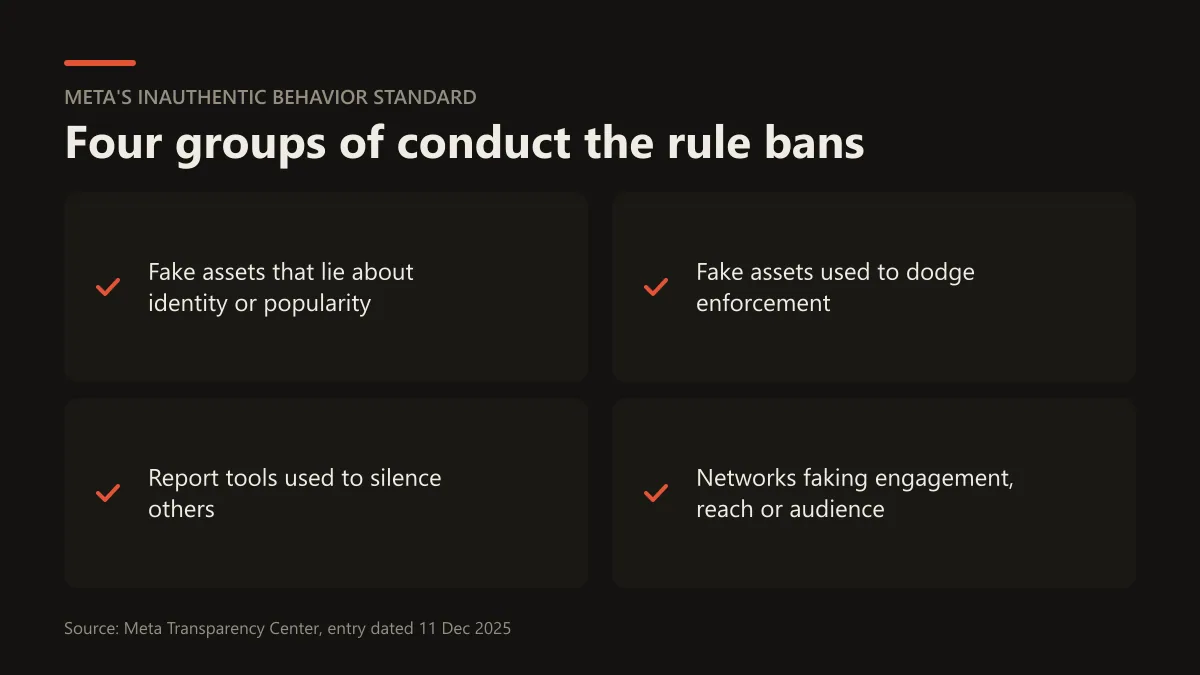
As of November 2026, the latest dated entry in the change log of the Inauthentic Behavior standard is 11 December 2025. The rule forbids using fake assets to deceive people about who runs an account or how popular it is. It forbids using them to evade enforcement. The 11 December 2025 version also lists complex deception such as inauthentic distribution, inauthentic audience building and inauthentic engagement.
The fourth group gets the least attention. Meta words it like this:
Misuse Meta reporting systems to harass, intimidate or silence others.
That line matters for anyone shopping for an Instagram mass report bot. Such a tool logs in to many burner accounts and files the same complaint from each one. The burner logins are fake assets, and the goal is to silence someone. So the script and its account list fall under this rule, not just the target. For the GitHub reporting script with the most stars, a closer look at how it works follows its login loop step by step and shows why it stops after three reports.
Meta's separate Account Integrity standard points the same way. Its list of banned conduct includes automation "such as scripting" and accounts made to evade an earlier removal. Vanquell covers the Telegram side of this in what a Telegram report can and cannot reach.
The rule also has a history worth knowing. Inauthentic Behavior became its own section on 10 October 2019, and the change log on Meta's page shows edits in 2020, 2022, 2024 and 2025.
| Change log date | What the entry shows |
|---|---|
| 10 October 2019 | Inauthentic Behavior becomes its own section (Meta change log) |
| 18 July 2024 | Foreign and government interference get separate definitions |
| 2 October 2024 | Coordinated inauthentic behavior reworded |
| 11 December 2025 | CIB wording revised again ("false identities" in place of "inauthentic accounts"); latest dated entry, the version quoted on this page |
Older guides still treat foreign interference as one bucket. The change log above shows Meta split it in two.
Instagram fake engagement rule: likes, follows and giveaways
The Instagram fake engagement rule says you may not collect likes, followers or shares artificially, and you may not pay money for them.
Instagram's guidelines put it in two short lines. One asks users not to be "artificially collecting likes, followers or shares." The other says not to offer money or cash giveaways for likes, followers or comments. Both lines sit on the Instagram Community Guidelines page.
Meta's longer rule adds the network angle. Its inauthentic engagement clause covers a connected set of fake assets used to deliver "substantial quantities" of fake engagement. A single person who buys a pack of likes breaks the guideline. A seller running hundreds of fake profiles is the network the longer clause describes.
Instagram has enforced this for years. On 19 November 2018 it announced it would remove inauthentic likes, follows and comments made through third-party growth apps. Flagged users got an in-app message and a prompt to change their password. Accounts that kept using such apps were told their experience "may" be affected.
For example, imagine a hypothetical bakery account, @crumbs.example. It pays a growth app $40 for 2,000 likes and hands over its password. Under the 2018 removal notice, those likes can be stripped and the owner told to change the password. The app still holds a working login until that change, and it can use the account to like other people's posts. That is the hidden cost of handing over a password.
Spam bots that sell the same "engagement" in comments sit under a related rule. The Vanquell guide to what gets spam accounts removed on Instagram covers that side.
Coordinated inauthentic behavior: Instagram applies a narrower charge
Coordinated inauthentic behavior (CIB) on Instagram means a sophisticated network, built around fake accounts, that tries to steer public debate.
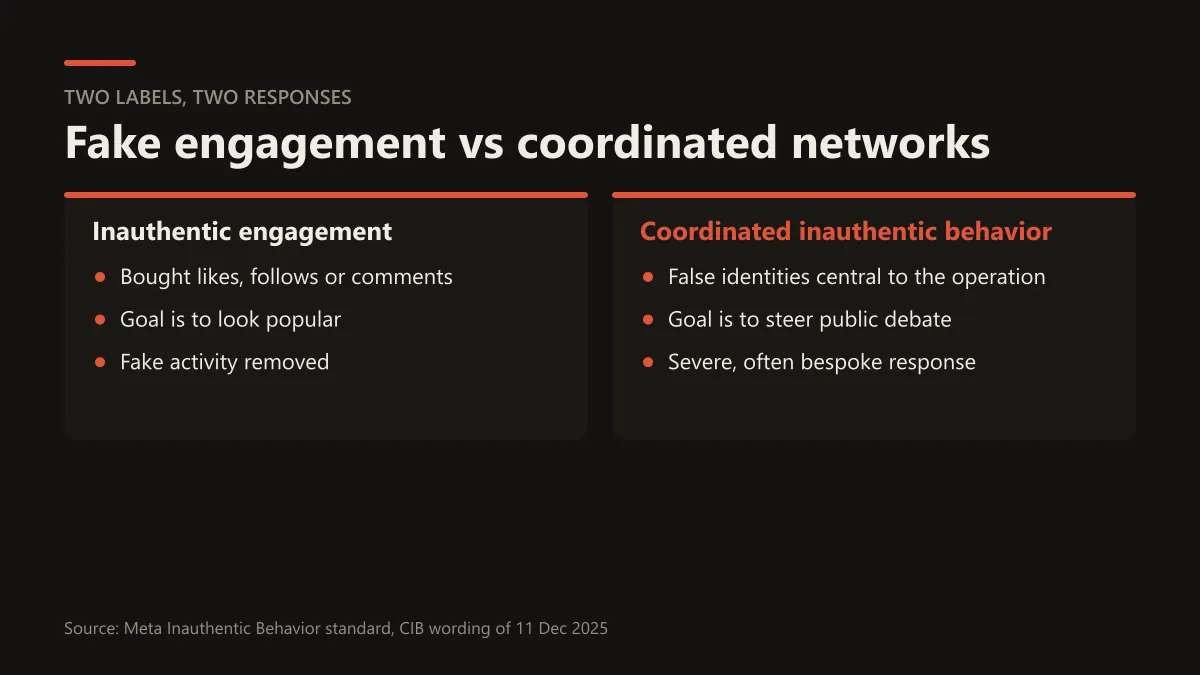
Meta's wording, revised in the 11 December 2025 entry of the standard's change log, describes "particularly sophisticated forms of Inauthentic Behavior where false identities are central to the operation." The operators use adversarial methods to evade detection or appear authentic. That version names two subtypes. Foreign interference is run from outside the targeted country. Government interference can be traced to a state actor.
A seller of likes is far from a coordinated inauthentic behavior Instagram case. It wants money, not a shift in public opinion.
The response also differs. The enforcement notes in the standard say Meta usually removes the fake accounts and Pages involved, and may leave real accounts that took no part. For coordinated networks the 11 December 2025 version promises "a more severe and often bespoke response" and shares findings in its Adversarial Threat Reports when it can.
CIB cases vs everyday fakes on Instagram
| What you are looking at | Where it sits in Meta's rule | Typical response Meta describes | Route and what you supply |
|---|---|---|---|
| An account buying likes or followers | Inauthentic engagement or audience building | Fake activity removed, account may be limited | Profile menu report under the closest reason; profile URL and dated screenshots |
| A ring of new profiles reporting one person | Misuse of reporting systems | Fake assets removed | One report per account from the profile menu; URLs of each profile and screenshots of the shared pattern |
| A new account made after a ban | Evasion, plus Account Integrity | New account removed | Profile menu report on the new account; link or screenshot tying it to the banned one |
| A network posing as locals to sway an election | CIB, with foreign or government interference as subtypes | Network removed, may be named in a threat report | One report per account; dated screenshots of the shared posts and profile URLs |
X draws a similar line in its own Authenticity policy, compared in what X acts on when reports pile up.
How does Instagram tell if an account is inauthentic?
Instagram looks at patterns across an account, not at one post, and it can ask the owner to prove who is behind it.
The clearest public example is from 13 August 2020. Instagram said it would ask some accounts to confirm their identity when it saw "a pattern of potential inauthentic behavior." Two signals were named. One is when most of an account's followers are in a different country from the owner. The other is signs of automation, such as bot accounts.
An owner who does not confirm can see the content get "reduced distribution," or the account can be disabled. Instagram also said the check would touch "only a small number" of users.
None of this needs a report from you. Detection runs on its own, which is why a pile of complaints adds little. The Vanquell page on TikTok's own removal figures shows the same pattern on another app.
Reporting a network you think is fake
File one clear report per account through Instagram's own menu, under the reason closest to the conduct you saw.
- On the profile, tap Options (the three dots) beside the username.
- Choose Report, then the option for the account rather than a single post.
- Choose a reason. For a profile posing as a real person, "Pretending to be someone else" is the one Instagram lists.
- Before you file, copy each profile URL and take screenshots that show the date and the shared pattern.
- File once per account and stop. A second report on the same item adds nothing.
These labels follow the steps Instagram lists for reporting a profile. If one of the accounts is posing as you, the Vanquell guide on which report route fits which situation walks through the impersonation form in detail.
What to do if your own account gets flagged
If Instagram flags your account, cut off any app that holds your password first, then use the review option Instagram shows you.
The 2018 notice told flagged users to change their password, since that revokes a growth app's access. Meta's Account Integrity rules also treat compromised accounts as a separate case, so a hacked login is worth saying plainly in any appeal. Remove unknown apps, check which devices are logged in, and turn on two-factor login.
When the reports are aimed at you, the fix is the same review route. A walk-through of what each report in a mass-report campaign really does covers how to answer a disabled-account notice, and Vanquell can read that notice with you against the rule it cites. If a seller claims they can lift a flag for a fee, the Telegram version of that pitch is unpacked in what each Telegram ban measure does.
Common questions
What is considered inauthentic behavior on Instagram?
What is inauthentic engagement?
Is it illegal to buy followers on Instagram?
Why does Instagram keep saying my account has suspicious activity?
Who decides that an Instagram network is CIB?
Does reporting a fake network many times help?
Can a giveaway break the fake engagement rule?
- Meta Transparency Center — Inauthentic Behavior standard and change log
- Meta Transparency Center — Account Integrity standard
- Instagram Help Center — Community Guidelines
- Instagram — removing inauthentic likes, follows and comments (2018)
- Instagram — identity checks for suspected inauthentic accounts (2020)
- Federal Trade Commission — final rule on fake reviews and fake social media indicators
Not sure which part of the rule your case falls under?
Share the accounts and a few dated screenshots, along with what made you think they are linked. Vanquell matches them to the clause in Meta's standard and names the official route that reaches it, or tells you nothing there fits. Meta makes the decision on every case, and we file nothing that is not a real breach of its rules.