TikTok Mass Report Bot vs 184 Million Removals: What TikTok's Own Enforcement Data Shows
TikTok removed 184,012,576 videos in the first quarter of 2026 and caught 99.3% before anyone reported them, per TikTok's Q1 2026 enforcement report. A TikTok mass report bot fights over what is left, where a reviewer weighs the clip against one named guideline. One report that names the right rule beats a thousand copies of a weak one.
- TikTok's Q1 2026 enforcement report puts the proactive removal rate at 99.3%, meaning almost every removal happened before a user flagged anything.
- The report channel is small but real: the remaining 0.7% works out to roughly 1.3 million videos in that quarter.
- Inside that channel the reported content is checked against one guideline, so a second identical report asks a question that was already answered.
- TikTok runs two web forms outside the app that cover cases the in-app Report button routes badly.
- TikTok reinstated 8,838,710 videos after further review in the same quarter, which is why an appeal is worth writing properly.

TikTok removed 184 million videos last quarter, and reports triggered almost none of them
TikTok took down 184,012,576 videos worldwide between January and March 2026 and recorded a 99.3% proactive removal rate, its term for content pulled before a user reported it. The same Q1 2026 Community Guidelines Enforcement Report attributes 178,014,154 of those removals to automated detection and puts 94.4% of them inside 24 hours of the video being posted.
Run the remainder and the reporting channel is not nothing. Seven tenths of one percent of the 184 million total, according to TikTok's published quarterly figures, is about 1.3 million videos that came down after a person flagged them, which is a real queue with real outcomes. It is also the exact queue a report campaign is aiming at, and the one place where its central assumption breaks. A submission there routes the clip to a classifier or a human reviewer who compares it against one specific rule, and that comparison returns the same verdict however many times it is requested. Volume is not an input to the check. It is only an input to how often the check runs, and the check is cheap to run and unmoved by repetition. Five hundred reports buy five hundred answers to a question that had one answer.
Accounts get the same treatment as videos. TikTok removed 86,288,705 fake accounts in that quarter, according to TikTok's own quarterly reporting, plus 25,764,372 more it suspected of belonging to under-13 users. If the profile you want gone is a bot farm or a recycled spam account, the systems that clear those are already running against it, and they are not waiting on anyone to report it.
Two honest limits sit on that figure. TikTok publishes removal totals, not the number of reports it received, so nobody outside the company can say what share of reports lead to any action. And a proactive rate says nothing about accuracy in either direction.
So what does a TikTok mass report bot actually change?
On the target's side, nothing the first honest report would not have done. On the sender's side, it manufactures the one genuinely new signal in the whole exercise: a burst of near-identical submissions traceable to a set of accounts, arriving at a system whose job includes noticing coordination.
TikTok is explicit that a reporting channel can be taken away from whoever abuses it. Its copyright removal form carries the line, printed above the first field: "Misuse of the removal request webform, such as submitting false information, may result in the suspension of using the webform or other legal consequences."
The pattern is not unique to TikTok. We wrote up the same tactic on X, where the platform supports a genuine multi-post report and treats duplicate-report floods as something else entirely. Different rulebook, identical arithmetic.
What are you actually buying when a page sells a TikTok mass report tool?
Three things, in practice. A public GitHub or GitLab script that hits an endpoint until it is rate-limited. An SMM panel reselling report actions by the thousand. Or a seller with nothing behind the screenshots at all.
The first two need a login or a session token to run, which is the entire risk in one sentence: you hand your account to a stranger so they can file a report that carries no more weight than the one you could file yourself. The panels selling the Instagram version follow the same script.
The two TikTok report forms most people never open
TikTok runs report forms on the web, outside the app, and two of them cover cases the in-app Report button handles badly.

The first sits at tiktok.com/legal/report/feedback and is titled Report a problem. It needs no login, which makes it the route for someone who does not use TikTok but has been targeted on it. Read its Topic dropdown before you pick: alongside Report a potential violation it offers Report an underage user, Account access / security, and Change account information, so a locked-out owner and a bystander reporting harm come through the same door under different labels.
The second is the copyright form at tiktok.com/legal/report/Copyright, and the capital C is not a typo. The lowercase path lands you on TikTok's generic legal page with no form on it, a small thing that has cost people an afternoon. The form states its own scope plainly: it is for infringements in user-generated content. That is the route when somebody reposted your footage, not when they insulted you.
Which form applies is the question we field most often, and we cover the evidence each one wants in our FAQ and across the platform guides we publish here.
Which official route fits your case?
Match the harm to the channel built for it, because a report filed under the wrong category is judged under the wrong rule and comes back clean. These are the five situations we see most.
| What happened | Where it goes | What to have ready |
|---|---|---|
| A video or account breaks a Community Guideline | In-app Report on the profile or the video | The clip link and the specific rule you believe it breaks |
| Someone reposted your video, footage or music | The copyright form at /legal/report/Copyright | Proof you own the original, plus every infringing URL |
| An account is pretending to be you | In-app report on the profile, impersonation reason | Links to your real account and anything showing it is yours |
| You have no TikTok account at all | The Report a problem web form, Topic: Report a potential violation | The profile or video URL and a plain description |
| Your own video or account was removed | The appeal attached to the notice TikTok sent you | The notice itself and the original upload |
Copyright and privacy complaints often move where a generic guideline report stalls, because both are checked against a narrower and more objective test. Picking that route is most of what our removal and takedown work consists of.
How to mass report TikTok content, and what to file instead
There is no supported way to mass report TikTok content, and the report flow offers no bulk selection, so the working move is one report per item, each naming the rule it breaks. Six violating clips from one account means six submissions, and each is judged on what it contains.
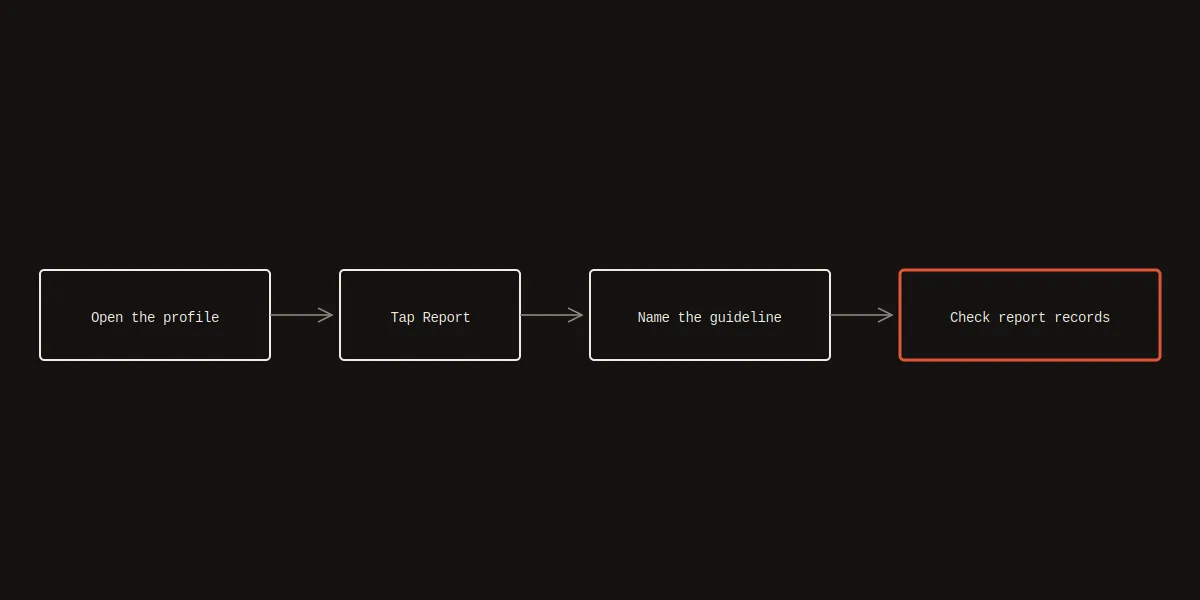
- Open the profile or the video and tap the share arrow, then Report.
- Choose Report account or Report video, then pick the reason that matches the actual breach rather than whichever option sits nearest the top.
- Give the form the specifics it asks for: which clip, which moment in it, and what rule the content crosses.
- Submit each item on its own. Bundling unrelated grievances into one report gets the whole thing weighed against a single guideline.
- Check the report records TikTok keeps under Support in your settings, so you know what was filed and what came back.
What moves a report is specificity. A reviewer opens your submission and sees two things, the clip and the category you picked, so a harassment report against a video whose caption names and targets a person reads nothing like the same category filed against a video the reporter simply disliked. Name the moment, name the rule it crosses, and stop there.
Screenshot everything before you file: the profile, the video, the caption and the view count. Content vanishes mid-case, and an evidence pack assembled afterwards is always thinner than one assembled first. When a client sends us that pack we hold it only for the case, on the terms set out in our privacy policy.
What if a report campaign is aimed at your own account?
A wave of reports against content that follows the rules ends where every other report ends, with a check that comes back clean. That is the design. It is also cold comfort at two in the morning with your notifications full and a video gone, so here is what the numbers say about getting it back.
TikTok reinstated 8,838,710 videos after further review in the first quarter of 2026, per TikTok's enforcement report for that quarter. Against 184,012,576 removals, that is roughly one decision in twenty-one revised on a second look. Appeals are neither a formality nor a lottery.
It is also worth asking what the wave is for. Where the target has an audience worth taking, reports can be the opening move of a takeover rather than the point of it: groups have filed false reports on Instagram until a profile locked, then approached support as the locked-out owner, per AlgorithmWatch's 2021 investigation into report brigades. The report-wave account trade runs on followers, so an account that grew a real one is the account worth taking.
Keep the notice TikTok sends you, because it names the guideline the decision was made under and that is the thing your appeal has to answer. Do not re-upload the removed video while the appeal is open, since a fresh copy is a fresh decision under the same rule. Write against the specific guideline cited rather than describing how unfair the situation feels, and if the account is restricted rather than banned, note exactly what you can and cannot still do, because that tells you which enforcement was applied. If the notice makes no sense against what you actually posted, send it over and we will read it with you.
What we take on, and what we turn down
We ask for three things before we file anything: the profile or video URL, dated screenshots of the content as it stands, and whatever TikTok has already told you. Then we decide which route the case belongs in and file there, once, properly. When a first submission is declined we look for a narrower test the same facts satisfy, usually copyright or privacy, rather than sending the same complaint again.
We turn work down too, and it is worth saying which. We do not file against content that breaks no rule, we do not run report campaigns, and we do not tell a client a removal looks likely when the honest read is that it does not. What we can commit to is the filing and the escalation, never the platform's decision. That limit is written into our terms, and the practice behind it is described on our about page.
If you are choosing between a panel and a properly filed case, file the case. A bot buys repetition of an answer you already have. A correctly routed report with evidence attached is the only thing that puts a new question in front of a reviewer, and that is the whole of what Vanquell does on TikTok. We would rather tell you it will not work than take the fee.
Common questions
Can a mass report TikTok account campaign get a profile banned?
Is any TikTok report bot safe to use?
How many reports does it take to remove a TikTok video?
Can I report a TikTok account without having an account myself?
What happens if TikTok rejects my report?
- TikTok Transparency Center — Community Guidelines Enforcement Report, Q1 2026
- TikTok — Report a problem web form
- TikTok — Report copyright infringement
- TikTok Support — Report a user
Working a TikTok case right now?
Send the profile link, the video URL and any notice TikTok gave you. We will read it, tell you which official route applies, and turn the case down if nothing in the content breaks a rule.