Instagram Spam Report Bot: What Actually Gets Spam Accounts Removed
An Instagram spam report bot fires repeat complaints at one profile, and Meta's Community Standards treat that traffic as inauthentic behavior rather than as evidence. Spam accounts come down through a correctly categorized report carrying screenshots and a profile link, or through the comment and message filters already built into your settings.
- Meta's Inauthentic Behavior standard treats misuse of reporting systems as a violation on its own, so the buyer of a report bot carries the risk, not the target.
- Instagram routes a complaint by the reason you select, which makes the category screen the most consequential tap in the entire flow.
- Meta says it removed more than 159 million scam ads across 2025 and caught 92% of them before any user report, per its integrity reporting published in March 2026.
- Hidden Words and Limits stop most spam waves on your own account in seconds, with no reviewer involved.
What does a spam report bot Instagram panel actually do to your account?
Three things, in this order: it takes a payment, it stores the username you typed in, and it fires repeat complaints from accounts that have no connection to you. Some panels ask you to log in with Instagram first so the bot can report "on your behalf". That step hands the seller a live session.
The buyer carries the exposure here, not the target. Meta's Spam standard prohibits posting, engaging or creating accounts either manually or automatically, at very high frequencies, and separately bans buying, selling or exchanging engagement of any kind. The Inauthentic Behavior standard is blunter still: it lists misusing reporting systems to harass, intimidate or silence others as a violation on its own, with no requirement that the reports succeed first. Instagram's Terms of Use add the contract layer, barring automated account creation and anything that interferes with how the service is meant to run.
So a panel puts your account inside two standards while leaving the target untouched. That trade is the entire product.
Can an Instagram report spam bot get an account banned?
No, and Meta's own enforcement figures show why. The company reported removing more than 159 million scam ads across 2025, 92% of them before anyone filed a report at all. Automated detection reaches most violating content first. A complaint that tells a reviewer nothing the classifiers have not already scored does not move the decision, and repeating it ten thousand times still tells them nothing.
TikTok publishes the equivalent figure for all video removals rather than one ad category: 99.3% of the 184,012,576 videos it took down between January and March 2026 came down before a user reported them, per TikTok's Q1 2026 enforcement report. The 0.7% remainder is still about 1.3 million videos, so what reports actually reach is a real queue and a narrow one.
Which spam bot Instagram report category should you choose?
Choose the one that names the exact rule being broken, because the reason you pick decides where the complaint goes. Instagram's flow branches at that screen. Select "spam" for a crypto scam sent by DM and it lands in a queue built for junk posting rather than for fraud.
| What you are seeing | Where to report it | What to have ready first |
|---|---|---|
| Identical comments dropped under post after post | The comment itself, then the profile if it repeats | Two or three comment screenshots with dates visible |
| DMs pushing coins, giveaways or investment groups | The message thread, reported as a scam | The thread, the profile URL, any payment handle quoted |
| A profile using your name and photos to message people | The profile, reported as pretending to be someone | Your identity document, both profile URLs |
| Waves of follows and unfollows from empty accounts | Nowhere yet; following is not a violation | Nothing until one of them posts something that breaks a rule |
| An account openly selling followers, likes or accounts | The profile, reported as spam | A screenshot of the offer and its price list |
Evidence is the other half of it. A report carrying two dated screenshots, the profile URL and a single sentence naming the rule gives a reviewer something to act on; a report carrying a bare username gives them a username. Instagram documents the mechanics as three taps: the three-dot menu on the post or profile, then Report, then the reason. Everything that makes the filing persuasive has to exist before you open that menu, because the form itself does not pause to let you gather anything.
At Vanquell we ask for the profile URL, two screenshots with the timestamps left visible, and one plain sentence about which rule the account broke, before any removal or takedown filing goes out. When a client cannot produce all three, we say so instead of filing. A report built on a hunch is the sort that comes back marked as not violating, and refiling the same hunch changes nothing about it.
How do you report spam bot Instagram accounts the right way?
Work from the content upward, not the profile downward. One violating comment or message is easier for a reviewer to judge than a whole account, and starting there gives you a narrower, more accurate reason list. Instagram takes one item per report, so an account spread across many posts gets filed piece by piece; on X a single complaint can carry several posts from the same handle, which is the nearest thing to a legitimate bulk report anywhere in this space.
- Screenshot the offending comment, message or post with the date visible, and copy the profile URL.
- Open the item itself, whether that is the comment, the thread or the post, and tap the three-dot menu.
- Choose Report, then pick the reason that names what the account is actually doing.
- Report the profile separately only when the behaviour runs across several posts rather than one.
- Block the account once the report is in, so the same bot cannot reach your posts while review runs.
What does an Instagram spam bot report actually contain?
Less than most people assume. The form sends the item you flagged, the reason you chose, and the account context Instagram already holds. It does not carry a written statement, and there is no attachment field. That is why the reason screen does so much of the work: it is very nearly the only variable you control. Your identity is not part of what the other account sees, either. Instagram puts this plainly in its guidance on abuse, spam and scams: "Your report is anonymous unless you're reporting intellectual property infringement. The account you reported won't see who reported them."
Where does a spam report Instagram bot complaint go after you send it?
Into a review queue, where it is judged against the standard you selected rather than counted against a threshold. Instagram says you may be able to check a report's status afterwards, and that is the whole of the visibility you get. No ticket number arrives, no reviewer writes back, and nothing can be added to the filing later.
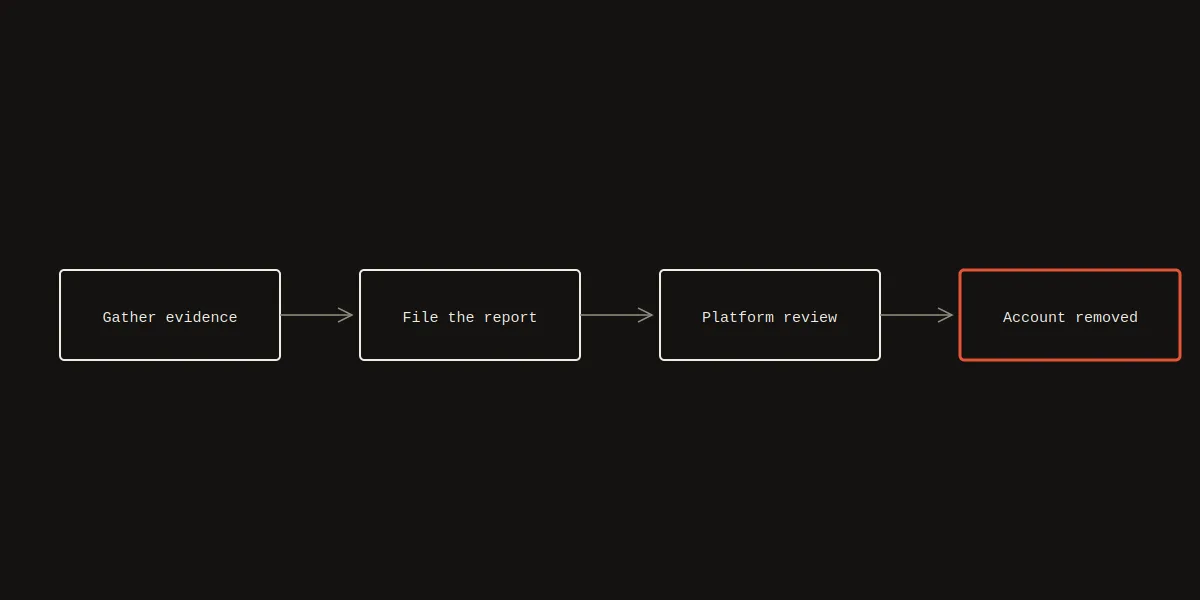
The outcome is not binary either, which is the part most guides skip. Instagram's reporting documentation notes that even where the content stays up, a report can reduce how often similar content is shown in Feed and recommendations. A spam account that survives your report can still lose the reach it was farming. Where a decision looks plainly wrong, the honest next move is a review request against that same decision, never a fresh report from a fresh account. The account on the other end of that decision has a sequence of its own, and the appeal routes in order matter because each stage expects the previous decision to already exist: Instagram's review, then the Oversight Board, with a further route open inside the EU.
That second account is precisely the pattern the Inauthentic Behavior standard describes. It is also the one step likely to draw attention toward you.
Shutting spam bots down on your own account without reporting each one
Filters beat reports on speed — they take effect the moment you save them, with no queue in between. Two Instagram settings cover most of what a spam wave actually does, and neither one waits on a reviewer.
Hidden Words lives in your privacy settings and pushes message requests containing words you list into a separate hidden folder. Instagram said when it launched the feature in April 2021 that all message filtering takes place on your own device, so nothing is sent back for review. Fill it with the vocabulary you keep seeing: the coin tickers, the giveaway phrasing, the account-recovery pitches. Limits, which Meta announced in August 2021, hides comments and DM requests from accounts that do not follow you or only started following you recently. That is close to a definition of a bot wave.
Should you report spam Instagram bot accounts one by one?
Only where each account has broken a rule you can point at. Fifty reports filed in one afternoon against fifty throwaway followers looks, from Meta's side of the glass, like the coordinated pattern its standards describe. If those accounts are only following and unfollowing, block them and switch Limits on. Where they are dropping scam links under your photos, report the comments; it is faster and far more precise than reporting fifty profiles. Comment-level reporting is the route we point people to most often, and the rest of our Instagram guides work the same way, from the content upward.
Can a spam report Instagram account bot remove a scam profile impersonating you?
No, and impersonation is where a bot does the most damage, because it burns the one route that works. A profile using your name and photographs to run a scam is reported under the impersonation reason, and that route asks for identity evidence no script can supply on your behalf.
This is the work we take on — and we are straight about its shape. We ask for the real profile, the clone, dated screenshots of what it is sending people, and identity documents where the platform demands them; we file through the official routes, and we tell clients when a profile does not qualify. Scope and pricing questions are answered in our common questions, and how we work is on the record. Whatever you send us is held under our privacy policy and our terms.
If a spam bot is in front of you right now, run the two-minute version first: switch Limits on, load Hidden Words with the words you keep seeing, then report the single worst post or message under the reason that names the rule it breaks. Skip the panels entirely. Where the account is impersonating you or running a scam at your customers, send us the link and the screenshots and we will tell you what is realistic before anyone pays for anything.
Common questions
How many reports does it take to remove an Instagram account?
Is using an Instagram report bot against the rules?
Can the account I reported find out it was me?
Instagram said the account does not go against Community Standards. What now?
Do the free report bot scripts on GitHub work?
Should I report a spam bot from a second account as well?
Will Vanquell run a mass reporting campaign against an account?
- Meta Transparency Center – Spam Community Standard
- Meta Transparency Center – Inauthentic Behavior Community Standard
- Meta Transparency Center – Integrity Reports, H1 2026
- Instagram Help Center – Report a post or profile on Instagram
- Instagram Help Center – Abuse, spam and scams
- Instagram Terms of Use
- Instagram – Introducing new tools to protect our community from abuse
- Meta Newsroom – Protecting our community from abuse on Instagram
Looking at a spam bot right now?
Send the link and two screenshots. We will read them, tell you plainly whether it breaks an Instagram rule, and say so just as plainly when it does not.