Telegram ban service measures: what each one does, and what reverses it
A Telegram ban service documents a violation and files it; Telegram decides what happens next. Its published measures run from suspended functionality and a FAKE or SCAM label through a frozen account to blocking or deleting the target, and most carry their own route back. No provider chooses between them.
- Telegram's EU guidance names three kinds of measure: suspending functionality, a FAKE or SCAM label, and blocking or deleting.
- Its FAQ and Spam FAQ add two more states with their own reversal routes: a frozen account and a limited one.
- Telegram commits to the least restrictive measure possible, so a case that supports a label should not be sold as a deletion.
- A bot, channel or sticker set banned for no apparent reason goes to [email protected].

The measures Telegram publishes, and only one of them is a ban
Telegram's User Guidance for the EU Digital Services Act sets out the actions its moderators can take under Regulation (EU) 2022/2065, and blocking or deleting an account is one item on that list rather than the list itself. Two more states appear in the FAQ and the Spam FAQ, and a sixth sits in the terms governing bots.
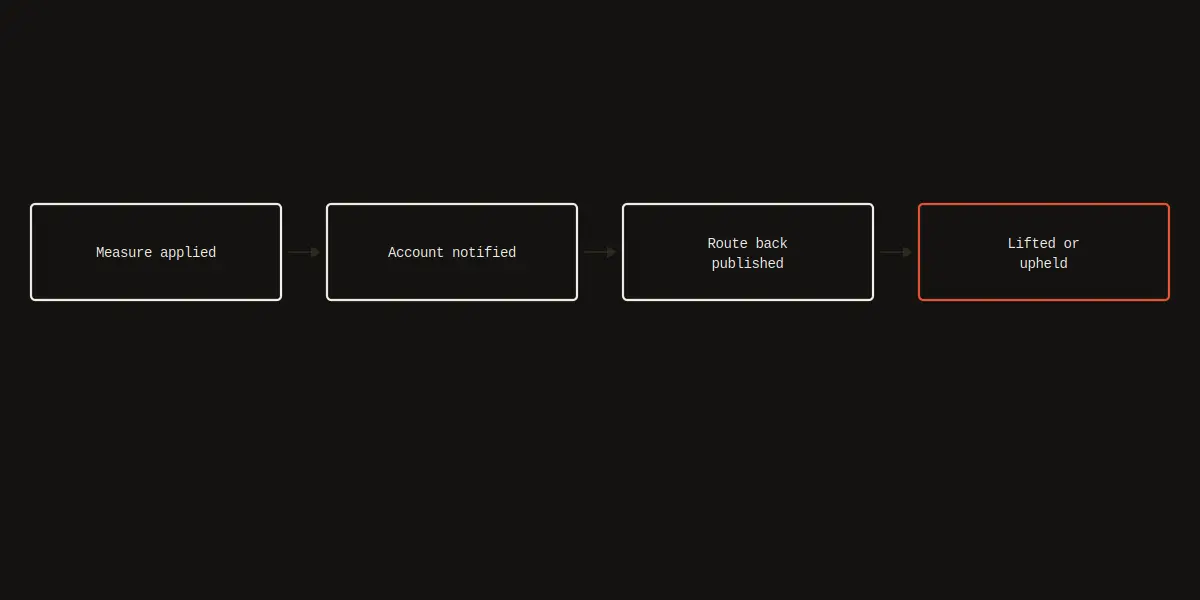
Telegram commits to favor the least restrictive measure possible, so a case that supports a label should not be recast as a deletion because a client asked for one. The last column is the one that changes the purchase: most measures carry a published route back.
| Measure | What it does | Stated trigger | Stated way back | Published in |
|---|---|---|---|---|
| Suspended functionality | Account survives, but loses the ability to contact people that likely do not know you, or to join and create public communities | Not stated | Certain restrictions may lift automatically | EU guidance |
| FAKE or SCAM label | A label displayed on the public profile of the account, bot or community | Impersonation, or attempting to defraud users | Telegram lifts a restriction made in error | EU guidance |
| Frozen account | Chats stay readable; the owner cannot send or post | Reports from other users | Appeal from inside the app | FAQ |
| Limited account | Can still message people who saved that number as a contact, and reply to anyone who writes first | Reported for spam, checked by human moderators | Contact @SpamBot | Spam FAQ |
| Removal from Bot Platform | A bot or Mini App removed from Bot Platform, or from store versions of Telegram | Failure to rectify legitimate payment disputes, shown by credible user reports | Not stated in those terms | Bot Developer Terms |
| Block or delete | The user, bot, post, channel or group is removed | Serious violations | Notice, plus guidance on removal; [email protected] for a channel, bot or sticker set | EU guidance, FAQ |
You are not buying an outcome — you are buying an argument for one of six, which is how our Telegram-first practice scopes this work.
What does a Telegram account ban service actually decide?
Two things, and the outcome is neither: which measure the evidence is aimed at, and how completely the case is documented before filing. Telegram's guidance keeps the rest, stating that any critical restriction requires approval from a human moderator.
Aiming is the underrated half — selling forged documents falls under a published prohibition, while impersonating a business is what the FAKE or SCAM label exists for, and the FAQ names @NoToScam for anyone being impersonated in person. The same screenshots argued two ways do not travel to the same place.
What no engagement can do is enlarge the surface. Telegram's own examples of what it takes down are sticker sets that violate intellectual property rights and porn bots, all on the public platform, which is the boundary what an engagement covers is drawn around.
Which promises cannot be true, whatever the price?
Any promise that fixes the outcome, the timing, or the access. Telegram publishes no outcome commitment, no response time, and no priority intake for paid providers, so a promise about any of the three describes the provider, not the platform.
- A guaranteed ban. Ask which published measure they are aiming at, and which prohibition they will name. A provider who cannot answer is forwarding, not filing.
- A fixed turnaround. Telegram publishes no decision time at all, so ask what the plan is when no reply comes back. That plan is the actual service.
- A refund if no ban. Ask what counts as the outcome. A FAKE or SCAM label is a real result, and a refund term written around the word ban quietly excludes it.
- Priority or insider access. Ask which named intake point they use. The routes a report can travel are open to anyone and cost nothing.
- Anything about a private chat. The FAQ closes this for every provider at once.
None of that decides whether a seller is honest. It holds each claim next to the sentence Telegram publishes about the same thing. Where the problem is volume rather than one target, Instagram's built-in comment filters show the shape of the cheaper fix.
Ask all five before any money moves. The answers are the diligence.
Can a Telegram ban bot reach any of these measures?
No, because a Telegram ban bot operates on a different layer entirely. The Bot API method that removes someone from a chat, banChatMember, states that the bot must be an administrator in the chat for this to work and must have the appropriate administrator rights.
That is moderation tooling for a community you already run. It removes a member from your group and has no path into the queue where Telegram's own measures are decided. Both are called banning, which is most of why the term is confusing, and they never touch.
Keep the distinction straight before paying anyone: a tool that bans from your chat reaches no row in the table above. Named report forms are a separate thing again, as the two TikTok report forms illustrate on another platform.
When Telegram publishes nothing that would apply
Being wronged is not the test; being inside a published prohibition is. Telegram lists what is not allowed on its public platform, and that list does not cover being rude, being a competitor, being wrong, or holding an opinion you dislike. Where the conduct is not on it, no measure applies, and evidence is what platforms weigh anyway, as what X weighs in a report shows.
The other large group is people whose harm is real and unreachable. Anything inside a private group or a one-to-one chat was placed beyond moderation deliberately, and the FAQ is unambiguous that Telegram will not act on requests about them.
That ends this road, not the road. Leave the group, preserve the messages with dates before anything is deleted, and treat conduct that is criminal where you live as a matter for the police.
How to get someone banned on Telegram is the wrong question
Telegram publishes what is prohibited, but for most measures it does not publish what triggers which one. The question that can actually be answered is which prohibition the content falls under, and that is the only part of the case anyone outside Telegram controls.
Should you hire a ban Telegram account service, or file it yourself?
File it yourself when the case is simple and the standing is obvious, because the intake points Telegram documents are open to anyone and free. One public channel, one clear prohibition, screenshots already in hand: that filing does not improve for being outsourced. Help earns its fee somewhere else entirely, where standing or scope is contested. Copyright complaints must come from the owner or an authorized agent, a documents problem before it is a takedown problem. Targets running across a channel, a bot and a Mini App sit under more than one rulebook at once. And a dismissed first filing needs someone willing to say the evidence was always thin, when it was.
What you buy there is labour and routing judgment, not access. What a first message should contain is the same list either way, and our standing answers on removals cover the rest.
What if the restricted account is yours?
Identify which state you are in, because each has its own published route. A limited account can still message contacts who saved that number and reply to anyone who wrote first, and Telegram sends anyone who believes the limit was wrongly applied to @SpamBot. A frozen account reads its chats but cannot send or post, and that appeal runs from inside the app.
Assets get a different address again. Where a channel, bot or sticker set was banned for no apparent reason, the Telegram FAQ invites the owner to write to [email protected].
One route almost nobody uses is worth knowing about. Publications taken down under the Terrorist Content Online Regulation, Regulation (EU) 2021/784, come with a published way to ask why, and how to challenge them: Telegram's designated European representative, EDSR, by post at Avenue Huart Hamoir 71 in Brussels, or the @EURegulation bot using the /tco_ask command, and the FAQ entry on EU removal requests notes those are accepted in English and French. That is a named human process with an address on it, which is more than most platforms publish. Longer appeal chains exist elsewhere, such as the appeal Instagram leaves you, traced across our other platform guides.
The standard we hold ourselves to before filing
Three things have to be on the table before a Telegram case opens here: where the content sits in public, evidence carrying its own dates, and the prohibition it falls under written out in a sentence. Where that third item is not obvious we write it with you, because a case that cannot name a rule is one we would be filing blind.
We check the surface first. Content in a private chat gives us nothing to file, and we say so rather than send something that will not be processed. Copyright claims from anyone other than the owner or their authorized agent fail on standing before the merits. We do not take work aimed at an account that has broken no published rule.
Those are commitments rather than a record, and the same ones sit in the engagement terms. Evidence you send is held under the limits in how long evidence is kept, and who you would be hiring covers the rest.
Common questions
Can a Telegram ban be reversed once it is applied?
Does Telegram say how long a decision takes?
What is the difference between a limited Telegram account and a frozen one?
Can a provider get a private group taken down?
What should a provider be able to tell you before you pay?
Is a FAKE or SCAM label worth asking for instead of a removal?
Can a Telegram bot be removed the way a channel can?
- Telegram — User guidance for the EU Digital Services Act
- Telegram FAQ — takedowns, copyright, frozen accounts
- Telegram Spam FAQ — limited accounts and @SpamBot
- Telegram Terms of Service
- Telegram Bot Platform Developer Terms of Service
- Telegram Bot API — banChatMember
Not sure which measure your case supports?
Send the handle, the public link, and the rule you think it breaks. You will get a straight read back: which measure the evidence could support, or that nothing Telegram publishes applies to it at all.