What counts as spam on Instagram, and what only looks like it
What counts as spam on Instagram is activity built to deceive or overwhelm people for reach: posting or following at very high speed, trading likes or follows, prize-for-engagement posts, repeated unwanted messages and deceptive links. Instagram's reviewers and automated systems decide each case against Meta's Spam standard, not by counting reports.
- Instagram applies Meta's Spam standard; its change log shows versions dated 2019, 2020, 2022 and 26 June 2024.
- Trading likes, follows, views or clicks is banned, and so are cash or prize giveaways tied to engagement.
- Meta publishes no safe number of actions; the standard says "very high frequencies" and also flags repetitive content.
- A spam report stays anonymous outside intellectual property cases, and filing it twice adds nothing.
- A private second account for friends is not spam under any Instagram rule.
Two things people mean by Instagram spam
Instagram spam means either content that breaks Meta's Spam standard or, in slang, a casual second account. Only the first one is a rule problem.
The answer to what counts as spam on Instagram depends on which meaning you have in mind. The slang meaning fills a good part of the search results for this question. A "spam account" in that sense is a private profile where someone posts unfiltered photos for a few close friends. Instagram has no rule against running one. It breaks nothing unless it poses as another person or comes back after a ban.
The rule meaning is the one that gets posts removed or accounts limited. Instagram's guidelines moved to Meta's Transparency Center on 12 November 2024, and the guidelines page says no rule changed in the move. Since then the detailed text that applies is Meta's Spam standard. It targets content built to deceive, mislead or overwhelm people so that something gets more views than it earned.
Vanquell is a small Telegram marketing and content takedown team that checks a reported post or account against that written standard before anything is filed. We prepare the case and name the official route. Instagram's reviewers and systems make the decision, and nothing we send can overturn one they have already made.
Instagram spam rules, line by line
Instagram spam rules come from two texts: the short Community Guidelines and Meta's longer Spam standard, which spells out each banned behavior.
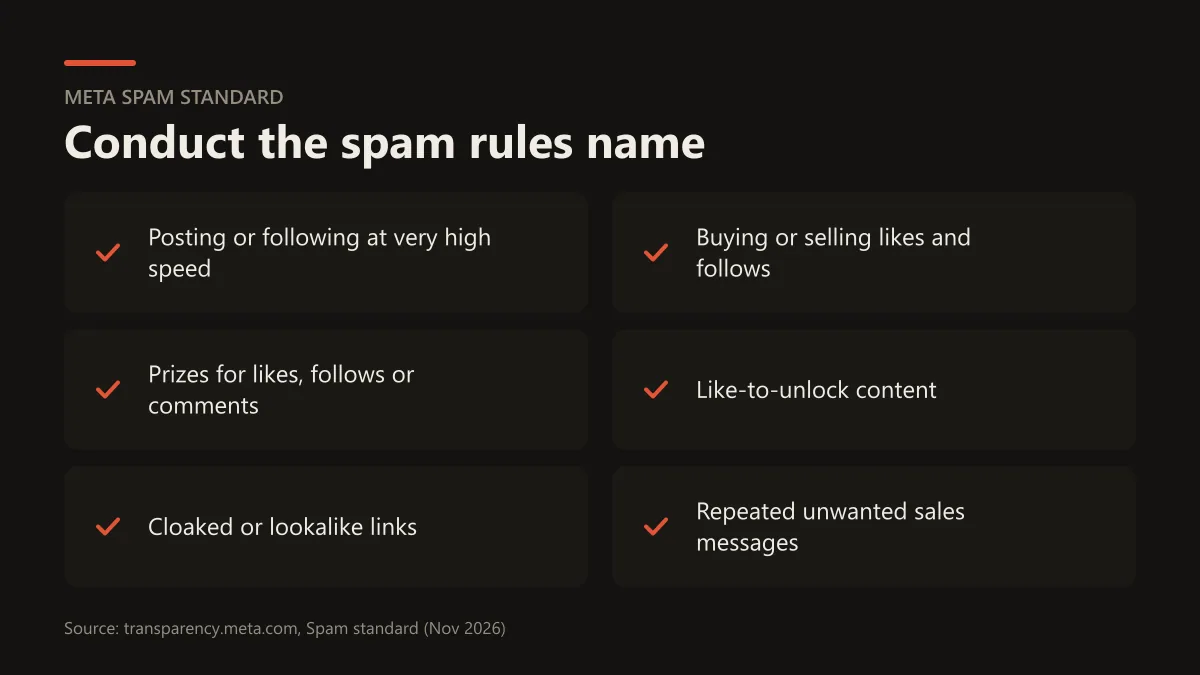
The table below puts both texts side by side. The left column is the conduct, the middle column says which text names it, and the right column gives a plain example.
| Conduct | Where it is named | What it looks like |
|---|---|---|
| Posting, commenting, following or opening accounts at a very high rate, by hand or by script | Spam standard | One identical reply left on dozens of strangers' posts within minutes |
| Buying, selling or trading likes, follows, views, shares or clicks | Spam standard and Community Guidelines | A pack of follows bought from a growth panel |
| Cash or valuable prizes in exchange for engagement | Spam standard and Community Guidelines | "Follow and like to win $50" |
| Making people engage before they see promised content | Spam standard | "Like this post to unlock the link" |
| Deceptive links: cloaking, misleading links, redirects, lookalike domains | Spam standard | A "free gift" link that lands on a fake login page |
| Repeated unwanted messages, or sales contact without consent | Community Guidelines | One sales DM sent to hundreds of strangers |
| Buying or selling accounts, Pages or admin roles | Spam standard | A post offering a handle for sale |
The standard's change log shows versions dated 30 October 2019, 17 December 2020, 30 June 2022 and 26 June 2024. An older version had a separate clause about luring clicks under false pretenses. As of November 2026 that idea sits inside the giveaway and engagement-trading lines instead.
Bought follower packs sit where two rules meet. The Spam standard bans the trade itself. The fake profiles that deliver those follows fall under Meta's inauthentic behavior rules, which the Vanquell guide to the Instagram inauthentic behavior policy sets out. That policy also covers coordinated networks of fake accounts and fake engagement sold at scale. So a buyer can face action under either text, and a seller under both.
One line in the Spam standard is easy to miss. Accounts that act at lower speeds can still be restricted when other signals show up, such as repetitive content or signs that the account is not authentic. Speed alone is not the test.
The standard also lists three exceptions. Cross-promotion is fine when nobody paid a third party for it. Handing admin duties to someone out of shared interest is fine. Branded Content is fine when it is clearly labelled as paid.
What looks like spam but is allowed
Posting every day, running a contest or messaging a customer is not spam on Instagram when the content is your own and the contact was wanted.
The Spam standard aims at deception and volume, not at enthusiasm. A creator who posts every day is not breaking it, since the text speaks of "very high frequencies" and the posts are real. A shop that answers a customer who wrote first is not sending unwanted contact. A second, private account for friends is a different audience, not a fake one.
Contests are where people slip. The Spam standard bans cash giveaways tied to engagement and offering valuable items in exchange for engagement. The line is what people do to enter.
For example, a hypothetical candle shop at example.com posts "Follow us and like this post to win a candle." That trades a prize for follows and likes, which is what the standard names. The same shop could ask customers to post their own photo of a candle with a shop hashtag and pick a winner from those posts. Now the entry is real content, and the rule's wording does not fit. Prize contests still have to meet Meta's promotion terms and the law where they run.
Consent decides the messaging question too. Instagram's guidelines ask users not to contact people for commercial purposes without their consent, and they remove unwanted messages sent again and again. Telegram draws a similar consent line, which Vanquell's note on bulk messaging routes Telegram allows for opted-in lists walks through.
Is there a number that makes activity spam?
No published number makes activity spam on Instagram; Meta's standard says "very high frequencies" and leaves the exact threshold to its own systems.
Charts that promise a safe number of follows or likes per hour come from marketing blogs, not from Instagram. The same goes for the "5-3-1 rule" and the "24 hour rule" that turn up in related searches. They are posting habits that some marketers suggest. Neither one appears in the Community Guidelines or in the Spam standard, so breaking them is not a violation and following them is no protection.
What the official texts do say is narrower. Instagram's Terms of Use rule out automated account creation and automated data collection unless Instagram has given express permission. That line covers any auto-follow or auto-comment tool that runs without Instagram's permission, whatever speed it runs at.
Detection also does not wait for someone to complain. Across 2025, Meta counted over 159 million scam ads removed, and in 92% of cases its systems acted before any user report, according to its integrity report for H1 2026. That figure covers ads, not every post, but it shows how much of the work starts with Meta's own systems.
How do you report spam on Instagram?
Report spam on Instagram from the menu on the post, comment or profile, pick the spam reason, and file it once.
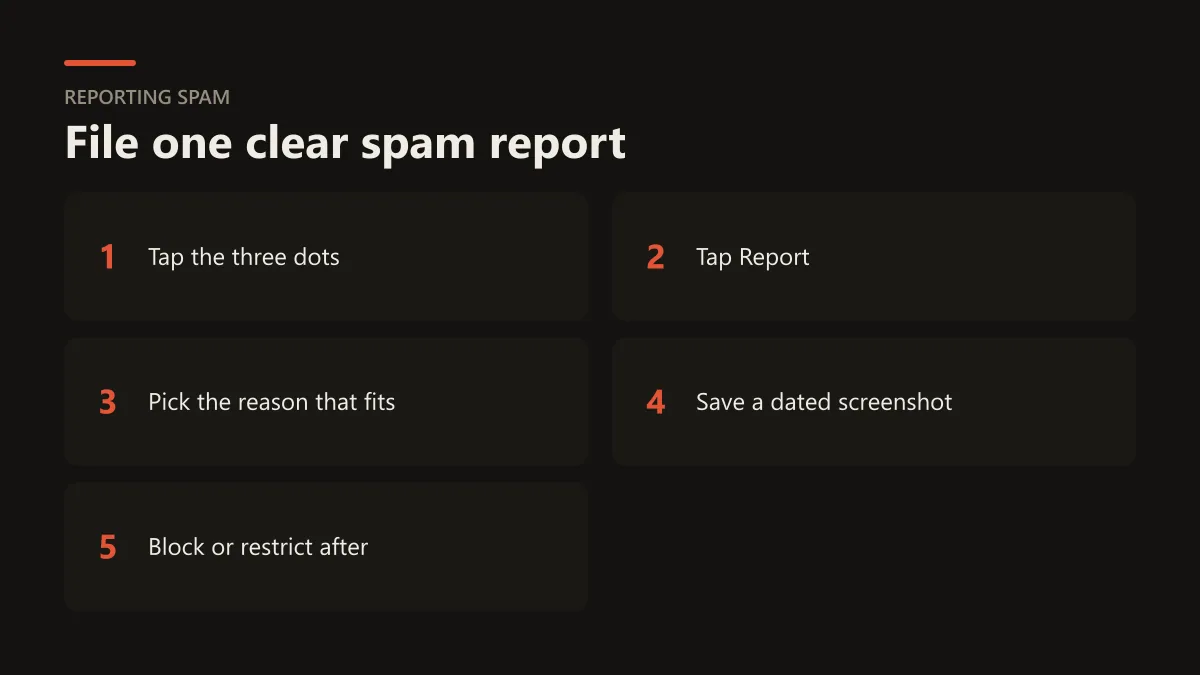
- Open the post, comment or profile and tap the three dots.
- Tap Report.
- Choose the reason closest to the problem. For plain spam, pick the spam option rather than a stronger label that does not fit.
- Before you file, take a dated screenshot and copy the profile link, since the account may vanish.
- Block or restrict the account afterwards so it stops reaching you.
Instagram's page on abuse, spam and scams answers whether the account learns who reported it:
Your report is anonymous unless you're reporting intellectual property infringement.
Filing the same report again does not help. Meta states in its help center that how often an item gets reported is not what decides its removal. The Vanquell guide to which report category fits a spam bot covers the reason screen in more detail. If the spam profile copies your name or your shop's identity, the general spam report is the wrong tool, and the impersonation form in the Instagram report routes guide fits better.
When Instagram treats your own activity as spam
If Instagram limits your account for spam, stop the repeated action, cut off any app holding your password, and use the review option Instagram shows you.
A growth or auto-reply app with your login is the first thing to remove, because the Terms of Use ban unapproved automation. Change your password, since that ends the app's access. Review the list of active sessions, sign out the ones you do not recognize, and switch on two-factor authentication.
Next, look at what you were doing when the limit appeared. Pasting one comment under many posts, sending one DM to many strangers or following in fast bursts all match lines in the Spam standard. Slow down and change the pattern rather than waiting it out and starting again.
If you think the limit is a mistake, ask for a review through the notice in the app. Say plainly what you posted and why it was your own content. Accounts hit by a wave of hostile reports face a different problem, covered in how a mass-report campaign works and how to answer it. A seller who charges to clear a spam flag cannot change Instagram's review; only the in-app review option reaches it.
Keeping spam out of your comments and messages
Hidden Words and Limits are the two Instagram settings that filter spam before you see it, without reporting each account.
Hidden Words sits in your privacy settings. It moves comments and message requests that contain words you choose into a hidden folder. When Instagram launched it in April 2021, it said the filtering runs on the phone itself, so nothing is sent off for review. Add the phrases you keep seeing, such as coin tickers, "DM to collab" pitches or fake giveaway wording.
Limits came in August 2021. Meta said it lets you hide comments and message requests from people outside your followers, or from those who began following a short time ago. That catches a wave of fresh spam profiles in one switch. Turn it off again once the wave passes, so real new followers can reach you.
Common questions
What qualifies as spamming on Instagram?
How do I know if an IG account is spam?
What do people post on spam accounts?
What is considered spam on social media?
What is the 5-3-1 rule on Instagram?
Is sending the same DM to many people spam?
Can a giveaway get flagged as spam?
- Meta Transparency Center — Spam standard and change log
- Instagram Help Center — Community Guidelines
- Instagram Help Center — Terms of Use
- Instagram Help Center — abuse, spam and scams
- Meta Help Center — how reports are reviewed
- Meta Transparency Center — integrity reports, H1 2026
Want a second read on a post before you report it?
Share the link, a dated screenshot and a line on what made it feel like spam. Vanquell checks it against the written standard and points to the official route that reaches it, or says plainly that nothing there qualifies. Instagram decides every case on its own review. Vanquell is independent and is not affiliated with Instagram or Meta. We never file reports in bulk, never ask for your password, and never report content that breaks no rule.